

The Objectives & Key Results (OKR) framework is a powerful goal-setting technique, which suits almost any organization at any stage of the life cycle. While it is simple and easy to use, companies can make mistakes when first launching OKRs. This article compiles the most common OKR mistakes followed by OKR best practices that will help you to avoid the most common OKR pitfalls, save time, and get the maximum value of OKRs.
OKR mistake 1: There are no agents of change
Assume the business decided to initiate a significant change — implement the OKR framework for the entire company. Frequently such initiation ends up with just throwing an idea into the team. The top manager may state the following:
— “I’ve heard OKR is cool stuff. You guys should start using it!”
— “Here is the excel template for OKRs. Please put your objectives inside!”
The next time you see the manager at the end of the quarter who’s asking: “How are things going?”
OKR best practice 1: Grow OKR ambassadors inside the company
There are numerous change management models — they all differ in nuances and approaches but agree on one thing — successful implementation requires change agents — people who are committed to the idea and willing to face resistance and failure.
You need to captivate people near you with the idea.
You need people who take on a key role in OKR implementation and maintenance. They are called OKR ambassadors, OKR shepherds, OKR leaders, or OKR coaches.
What does the OKR coach do?
- Leading the OKR process on the company level (or its parts), namely: planning, retrospectives, check-in meetings, and wins celebration.
- Organize and maintain a space for recording OKRs. If necessary, they remind all participants to update their progress information.
- Act as OKR evangelist and explain the core elements of OKR to all participants. They continuously learn and study the experience of other companies.
Who can act as a coach?
If the company already has Agile coaches, they can take on the function of implementing OKRs. It shouldn’t be a separate position, but just a role that one of the employees takes on, regardless of the hierarchy and primary occupation. Ideally, there should be several coaches, even better, when the new people are willing to volunteer. Often HRs, marketers, or product managers become OKR coaches. Taking on the OKR coach role is an excellent diagonal growth opportunity for frontline employees. In this case, an employee becomes responsible for the organization of OKR activities for the entire company and managers at all levels, including the top one.
OKR mistake 2: Run OKRs without training employees
There are cases when teams start to write their objectives without a thorough understanding of the OKRs methodology and its core principles, ideology, and approaches. They concentrate upon rituals and tools but not the results. In this case, the OKR implementation is becoming a goal in itself. Managers have heard that there is a fashionable OKR software used by FAANG level companies.
The company generates significant activities around the implementation process: hires new staff, forms new departments, develops instructions, and signs memos. It usually leads to blurring the essence of OKRs — transparency, and simplicity.
OKR best practice 2: Focus on outcomes, not tools
At the very beginning, it is vital to learn how to apply the OKR framework and educate all participants to follow the process. In the ideal case, it takes two or three OKR cycles to fine-tune the process. However, as the practice shows, it takes much longer. First, you can use very simple tools that do not require investment. Plan OKRs in a mind map, Google Docs, or on slides. Later you can switch to a simple task planning tool and track OKRs there. It would allow you to assign KRs and track their progress. Of course, the standard functionality of most task trackers is not well suited to run a full-fledged OKRs cycle. A dedicated OKR software shortens the implementation period. It provides you with additional benefits like alignment, advanced progress tracking, communication on objectives, simple and easy check-ins, reporting, and much more!
OKR mistake 3: Having too many objectives
It usually happens in companies where planning is not well developed. After reading an OKR book, employees realize that they must have five goals, and each must have up to five key results. — “There is no time to explain. Managers have said to set goals. Go ahead!” More so that there are so many objectives and things to do. Sometimes a team stops once it sets five objectives along with five key results. But there are cases when participants have seven, ten, or even twelve objectives, and each contains lots of metrics.
OKR best practice 3: Less is better
One of the OKRs superpowers is a focus. OKR implies setting ambitious goals that may require significant efforts to achieve. OKRs focus the entire team or company on the most important things for the upcoming period. So, it is better to focus on 2 - 3 quarter goals and achieve them rather than having 5 - 7 goals and finding yourself running into the sand at the end of the quarter.
Set goals in a way you could be proud of your progress on it at the end of the quarter. If you can break into the market leaders only in two years, do not set this goal starting from the first quarter. If there is no progress, the interest and focus will disappear.
OKR mistake 4: Employees have no idea where objectives are stored or have limited access
We have set objectives! But where are they?
There are cases when managers keep objectives approved on a strategy session somewhere in personal documents with limited access to a wide audience.
Here is a cite from a dialog with a c-level manager:
— “Last year, we invited a coach and set goals, but we achieved almost nothing.”
— “Oh really? Can you please show me what goals you set to understand the context?”
— “Well, I need to find them. I can’t do it that fast.”
— “Ok, but what happened to the goals after the strategic session? How were they implemented?”
The answer is obvious — objectives remained on flip charts or wall stickers once the strategic session was over. This case is similar to how we all made wishes in childhood. We wrote down our wishes on paper and put them under the pillow, hoping that magic would happen soon and all the wishes come true! It doesn’t work like that in business.
OKR best practice 4: Have objectives accessible to everyone
OKR implies that employees can view everyone’s objectives down to the CEO. Researchers demonstrate that open goals are most likely to be achieved. 92 % of U.S. employees admitted they would be more engaged to achieve results if colleagues could see their progress. Transparency facilitates cooperation and reduces suspicion, idleness, and intrigue. Therefore, the business significantly reduces unnecessary efforts, saves time and money, and achieves incredible productivity. The best OKR practice is to add objectives into a dedicated OKR software, if any, or in a google document. Employees must have accounts to enter into the software and access all objectives. In case OKRs were placed in a Google Doc, one must be shared among all participants. Thus employees of all levels can access the company objectives and see who is doing what and understand how they can be helpful to achieve the company’s OKRs.
OKR mistake 5: Set OKRs and leave them alone
In books and articles, the main emphasis is on the formulation of the correct OKRs. Indeed, setting goals is a time-consuming process that takes all the energy of enthusiasm.
— “Finally! We set OKRs!” — employees say with relief and satisfaction, wiping sweat from their forehead.
— “Now we can relax and return to our normal work” — and they switch back to their daily routines.
Do not think that formulating perfect objectives and adding them to the cutting-edge OKR software is the proper OKR implementation. It is one of the most common OKR mistakes that lead to a waste of time. Once teams have their goals set, they start working on them and stop for the result assessment only at the end of the quarter. It is not how OKR works. Priorities can change over time. You might have been working on a goal that is no longer relevant, and the one that required additional efforts was ignored. It may happen that the goal you are working on cannot be achieved for some reason. Without timely situation analysis, you would not have the ability to focus on other objectives.
OKR best practice 5: Review your OKRs on a regular basis
The OKR requires regular activities such as:
Regular meetings (usually they are called check-ins) where participants can synchronize, discuss problems, and progress. Teams that already use OKRs state that regular check-ins are extremely useful and help everyone remains focused on the same goals. Check-ins frequency depends on the communication level inside the team and the ability to predict the outcomes based on the team’s execution. An additional advantage of regular check-ins is that they may help re-focus the team efforts during the quarter. If the overall priorities change, the team can abandon objectives that will not happen and focus on those that will benefit from additional resources.
Success celebration meetings — where participants share their positive experience in attaining objectives.
Retrospectives — meetings where teams analyze the past OKRs periods to improve the upcoming ones.
To learn more about OKR cadence, please read this article.
OKR mistake 6: OKRs are treated as epics and tasks
In tech companies, people usually operate with epics and tasks. One of the most frequent OKR pitfalls while implementing the framework is when participants treat objectives as epics and KRs as tasks. When setting up quarter goals, employees define their objectives as epics and break them down into task actions represented as key results. It happens when OKR is implemented without the necessary staff training, employees transfer their experience with epics and tasks to the goals and key results setting.
Below is the example of an incorrect OKR:
Example:
Objective: Run an email marketing campaign for a new product
Key result 1: Build a target email list
Key result 2: Develop an email chain with a dedicated design for each letter
Key result 3: Track and report email performance
In the example, the objective describes a project or activity, not an outcome, impact, or result. The objective is followed by the Key Results, which are actions without quota targets.
OKR best practice 6: OKRs aren’t epics and KRs aren’t tasks
The following scheme demonstrates how OKRs, projects, and tasks work together.
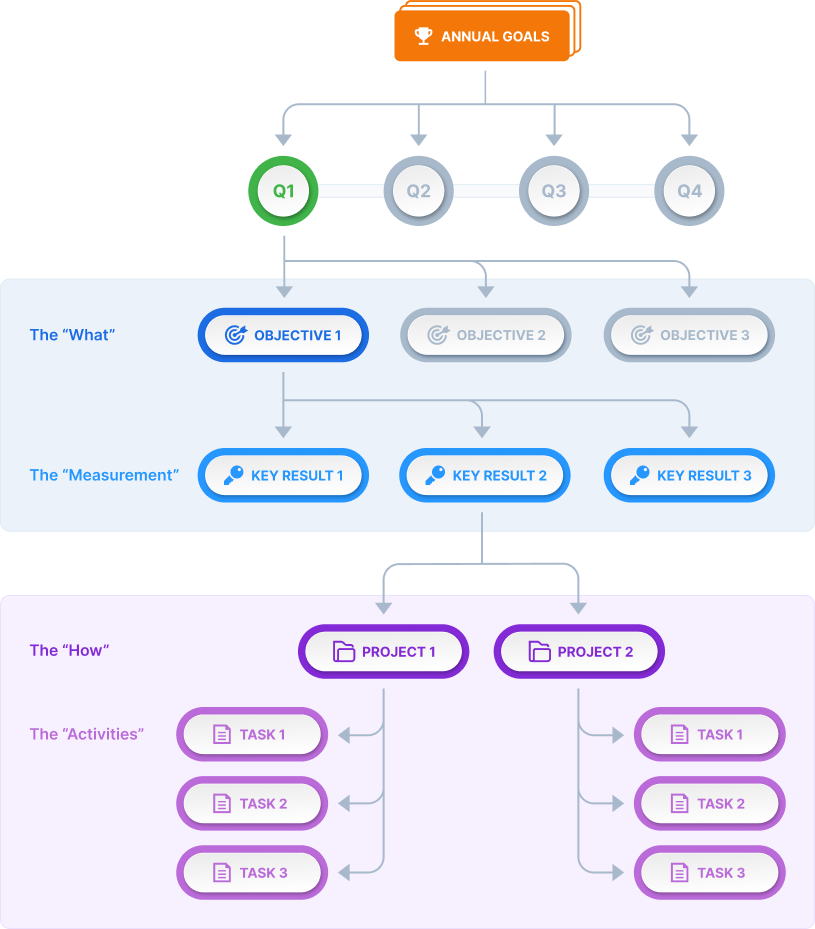
Let’s rethink the goal defined above. It is required to understand what result are you going to achieve by running the email campaign? Probably your objective is one of the following: drive sales and revenue, increase brand awareness or keep customers engaged. Now, think about how you will measure the goal? Brand awareness, for example, can be measured by counting your social media followers, website traffic, or look at increasing the search volume data. Note, they aren’t tasks — they are metrics.
Once your objectives and key results are defined, you can move to the next level and plan how you are going to fulfill the defined metrics and goals. You can initiate a project to run an email marketing campaign, then plan and estimate dedicated activities.
Eventually, we got the enhanced OKR example:
Example:
Objective: Increase brand awareness
Key result 1: Increase social media followers from 600K to 1M
Key result 2: Increase organic website traffic from 10K sessions per day to 25K sessions
Key result 3: Partner with 10 influencers to review our brand
OKR mistake 7:Confuse KPIs with OKRs or have both at the same time
Another typical OKR pitfall is when companies take their existing KPIs and make them more ambitious. Even worse when they rename existing KPIs to OKRs. Then objectives lose ambition, which negatively impacts business outcomes. Once employees hear that achieving goals by 60-70% is considered successful OKRs — another negative effect happens — employees receive an internal indulgence not to complete things at all. If not informing employees of why they need ambitious goals, they would seek to achieve their objectives by 60% and think this is OK. Such misconception leads to the reduction of KPI metrics while OKRs remain not ambitious enough to result in a significant change.
Moreover, there is a direct connection between KPIs and the compensation system. The general idea of linking financial rewards to KPIs is simple — track the employees’ performance, if they are performing well, give them a bonus that will motivate them to deliver even better results. There are cases when companies apply the same logic towards OKRs. In this case, employees refuse to set ambitious goals because their compensation depends on the achievement. Consequently, the company loses opportunities for disruptive innovations.
OKR best practice 7: KPI for operations and OKR for growth and development
The difference between KPIs and OKRs is similar to the difference between Agile and Waterfall.
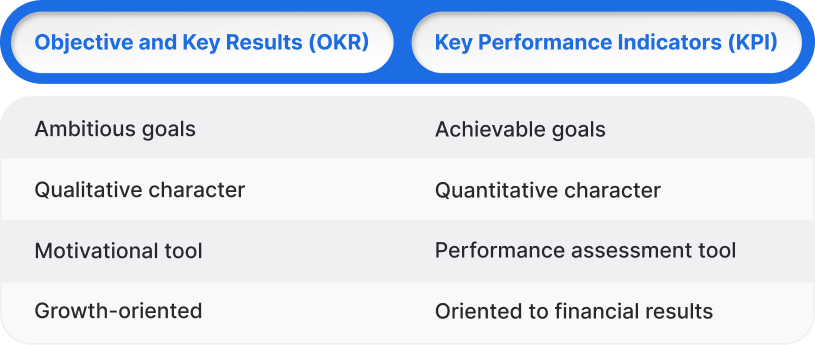
KPIs are more focused on current operations to give an understanding of how the business works now. And the performance evaluations are dedicated to how an employee performed in a given period – should be independent of their OKRs. Do not use OKRs as a “stick” or “carrot” in performance evaluations. It is a bad practice to tie OKRs directly to bonuses — “in case you achieve your OKRs, you receive your bonus.” This behavior will cause employees to consider OKRs as an administrative tool.
OKR is about change, about improving current products or creating new services and goods. Changes and innovations are only possible when people do not focus on potential financial punishment while taking all risks and achieving their ambitious goals.
OKR mistake 8: Setting top-down OKRs only
If OKRs are imposed by a directive from above and the performers are not involved in the goal-setting process then there is no need to call it the OKR buzzword. Typically this happens if a company has a rich legacy of directive management, backed up by well-designed top-down KPIs. At the beginning of the OKR implementation, it can be tempting to gather С-level managers and decide what the goals for the next quarter will look like. There is a pitfall in such a process. Due to the sheer number of tasks, managers may not be aware of what is happening on the battlefield. People who receive tasks from the top may see that they are either irrelevant or unrealizable since they are very complex or not understandable. The next quarter, managers may understand the mistake and say: - “Let the employees draw OKRs up, as they see the processes from the inside.” However, this is not an ideal way as well. A senior developer knows well how to make an application fast and user-friendly, but they may not be aware of the company strategy — where it should go, what goals are vital for the business, or how to increase the audience and conversions. One may have a general idea but this is not their main job.
OKR best practice 8: Combine the bottom-up and the top-down approaches
One of the principles of OKR is both top-down and bottom-up goal setting. What does it mean? A good practice is to adhere to the “from the general to the particular” logic. It means you need to set the company-level objectives first, then proceed to divisional OKRs and complete the process by setting individual goals. The bottom-up principle should work at the stage of setting the company’s OKRs. Invite an extended management team to the strategy session. It is a good practice to collect opinions from employees of all levels, which can help to determine the company’s focus for the upcoming quarter.
After setting top-level goals, teams come together to define OKRs for the next level. Not only should the manager participate in the goal-setting process, but the maximum possible number of employees involved in the implementation of these goals.
This process, of course, takes much longer than traditional top-down planning. But remember the saying: “If you want to go fast, go alone. If you want to go far, go together.”
Involving employees in the goal-setting process will help to synchronize the understanding of the current priorities and feel responsible for achieving the goal. When a team defines an objective — which means a goal is not dictated from above — participants will have more internal motivation.
Afterword
To ensure successful OKR implementation, you need to transform your mindset and approaches to business management. There is even more — you need to be ready to change the entire company culture. OKRs are hard work focused on maximal involvement of employees in global processes.
There is no silver bullet — the only true way to implement the framework. You need to be able to adapt to new conditions and adapt the framework for yourself because OKR allows you to do this.
“OKRs have such enormous potential because they are so adaptable. There is no dogma, no one right way to use them; it’s up to you to find your points of emphasis and make the tool your own.”
— John Doerr, Measure What Matters
 OKR and Performance management
  OKR and Performance management