

If your business wants to ensure consistent growth, it’s critical to understand the current state of things, track the progress your teams are making towards achieving your business goals, and know what’s working and what isn’t. OKRs and KPIs can help you do just that. But how and when should you use OKRs and KPIs? And what’s more important, what are the key differences between them?
In this blog, we’ll look deeper into OKRs (Objectives and Key Results) and KPIs (Key Performance Indicators), compare OKR vs KPI examples, and explore how they can complement each other in a business environment.
What are KPIs (Key Performance Indicators)?
Most businesses are certainly familiar with KPIs, or Key Performance Indicators, that are widely used to measure various aspects of business performance. KPIs are basically quantifiable measures of success that show you how something is performing against industry standards or your goals and expectations over a specific period.
You can track nearly anything with KPIs — your financial and operational efficiency, sales and marketing performance, customer success, or anything else in between. That also includes the performance of teams and individual employees.
Senior executives and managers keep track of the critical KPIs to ensure that the business meets its goals and make more informed, data-driven decisions about the future objectives and improvements that need to be made across an organization.
What are KPI Examples?
While every business will have a unique set of KPIs and metrics to track, here are a few examples of some of the commonly used Key Performance Indicators that are typically measured across marketing, sales, and customer success teams.
Marketing KPI examples:
- Marketing Qualified Leads (MQLs)
- Sales Qualified Leads (SQLs)
- MQL to SQL Conversion Rate
- Customer Acquisition Cost (CAC)
- Customer Lifetime Value (CLV)
- Return on Ad Spend (ROAS)
Sales KPI examples:
- Sales Conversion Rate
- Average Order Value
- Average Sales Cycle Time
- Upsell and cross-sell %
- Trial Conversion Rate
- Monthly Sales Growth
Customer success KPI examples:
- First Contact Resolution (FCR) rate
- Average Resolution Time
- Customer Satisfaction Score (CSAT)
- Customer Effort Score (CES)
- Net Promoter Score (NPS)
- Customer Retention Rate
- Customer Churn Rate
What are OKRs (Objectives and Key Results)?
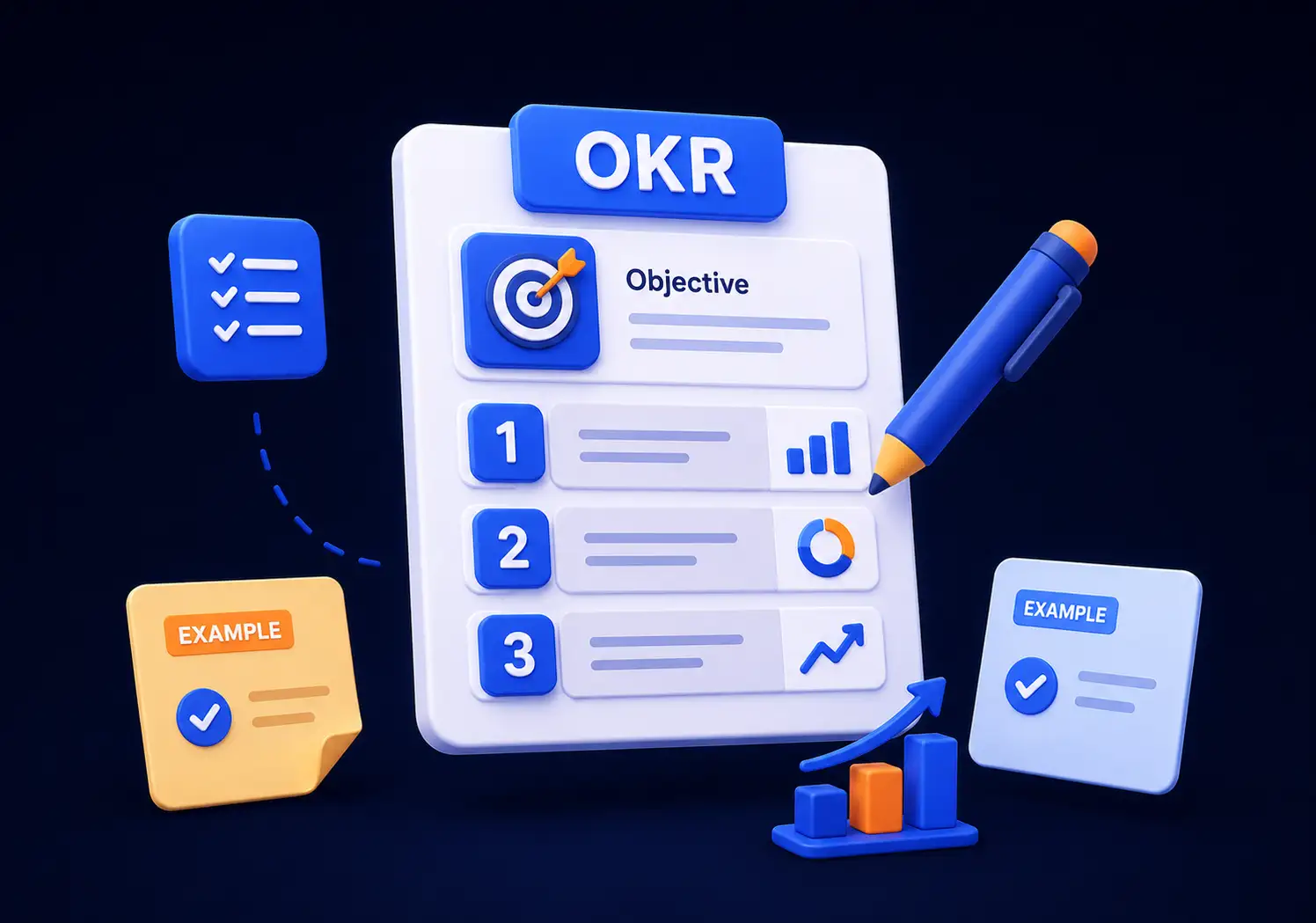
OKRs (Objectives and Key Results) go one step further in measuring and driving business performance. While KPIs are simply standalone performance indicators, OKRs is a complete goal-setting and management framework, making it a broader concept. Businesses set OKRs to give their teams a clear direction and vision backed up by context.
OKRs consist of two components: the Objective and the Key Results. Objective outlines a specific goal you are seeking to achieve over a certain time period, typically a quarter. That is usually an ambitious, aspirational goal that can motivate your team and drive meaningful change within your organization (e.g., ‘Boost our customer acquisition’).
Key Results describe the measurable and verifiable outcomes required to accomplish your Objective that also serve as a measure of progress towards the Objective (e.g., in relation to the mentioned above Objective, Key Results could be something like ‘Increase monthly trial sign-ups by 30%’ and ‘Increase the trial to paid conversion rate by 20%’).
What are OKR Examples?
You can set OKRs at different levels of an organization — company OKRs, department OKRs, team OKRs, and individual OKRs. These are some examples of Objectives and Key Results that can be set for marketing, sales, and customer success departments.
Marketing OKRs example:
Objective: Improve our newsletter performance and grow our subscriber list
Key Results:
- Grow the number of newsletter subscribers to 15,000
- Increase the email open rate from 15% to 25% by A/B testing headlines
- Achieve a CTA click-through-rate of 10%
- Reduce the unsubscribe rate by at least 30% by implementing the double opt-in process
Sales OKRs example:
Objective: Grow our sales and achieve record revenues this quarter
Key Results:
- Increase sales by 20% this quarter
- Increase the average order value by 20% from upselling and cross-selling
- Reduce cart abandonment rate by 10% by optimizing the checkout process
- Increase customer retention rate by 5%
- Increase repeat purchases by 10% through loyalty incentives
Customer success OKRs example:
Objective: Improve the efficiency of our customer support to boost customer satisfaction
Key Results:
- Increase FCR rate across all channels by 20%
- Reduce the average first response time for tickets to under 24 hours
- Reduce call abandonment rate by 30%
- Reduce the average resolution time by 50%
- Achieve a CSAT score of over 85%
Key Differences Between OKRs and KPIs
While these KPI vs OKR examples clearly demonstrate the difference between OKR and KPI, let’s take a closer look at how these two differ. Despite the fact that both can be set at different organizational levels (company, team, or individual), the purpose and the intention behind them aren’t the same.
KPIs are benchmark targets that simply provide insights into the present state of business performance without giving you much context on what adjustments or improvements are needed. OKRs, on the other side, give you a larger vision into where your organization is headed and what you are striving to achieve while also enabling you to align everyone within your organization around achieving common goals.
Here’s a comparison chart that highlights the key differences between OKRs and KPIs:
| Objectives & Key Results | Key Performance Indicators | |
|---|---|---|
| Definition | OKRs is a goal-setting framework that involves setting Objectives and Key Results that measure progress towards these Objectives. | KPIs are quantifiable business performance metrics that indicate how well an organization is functioning. |
| Scope | OKRs serve as a goal management methodology that embraces a wider scope than that of KPIs. | KPIs are often incorporated into broader goal-setting methodologies, such as OKRs. |
| Purpose | OKRs align everyone within an organization around aspirational goals that drive business growth. | KPIs help to measure performance and provide insights to make more data-driven business decisions. |
| Timeline | OKRs are usually set for a specific timeframe, typically quarterly. | KPIs are measured over different timeframes (daily, weekly, monthly). |
| Direction | OKRs are prospective and future-oriented. | KPIs are retrospective and measure past performance. |
| Flexibility | OKRs are flexible and are often reviewed, revised, and adjusted as needed. | KPIs generally remain consistent over longer periods. |
Can You Use KPIs and OKRs Together?
Since OKRs and KPIs aren’t mutually exclusive, they can definitely work strategically in tandem to help you assess your business performance, set and achieve ambitious goals, enable better decision-making, and drive your business growth. While KPIs are obviously essential to have to keep track of your critical business metrics, there are basically two scenarios when you would benefit more from turning your KPIs into OKRs.
First, when you are apparently lagging behind your KPI targets, leveraging OKRs can quickly and efficiently put things back on track by giving your team a clear direction and keeping them focused on the most critical tasks. Second, if you’re looking to significantly improve your KPI targets (like hitting bigger monthly sales numbers), OKRs can serve as a powerful engagement, motivation, and productivity booster for your team, helping you achieve your desired KPI targets faster and more effectively.
Final Thoughts on OKR vs. KPI
Whatever your business size and the industry you’re in, you can surely benefit from setting the right Objectives and Key Results and incorporating KPIs into your OKRs to drive meaningful improvements and achieve lasting growth and success in your business. That said, you also need a solid OKR management platform to help you set, manage, and track the progress of your OKRs in a convenient and efficient way. Effortbox has been designed with that purpose in mind.
Start for free now to see how professional OKR management software can simplify and optimize the entire process of setting, managing, and tracking your OKRs.
 OKR and Performance management
  OKR and Performance management
  OKR and Performance management