

Managing teams and companies more agile and fluidly is a good practice that continues growing globally. Integrating OKR (Objectives and Key Results) in your business processes gives you even more agility — because it is based on managing and planning with quarterly increments.
Driving agility comes from the management cycle of reviewing results and updating objectives quarterly, with annual company-wide priorities backed by both weekly and monthly progress reporting.
OKR cycle diagramm
OKR consists of two base components, they are:
- Objectives — a description of what you are going to achieve within a specific period
- Key results — a set of metrics that measure your progress towards defined objectives.
Although there is no standardized approach that would declare how to implement OKR — its results directly depend on how you operate with those base components during the selected timeframe.
The following diagram illustrates the annual and quarterly OKR cycles.
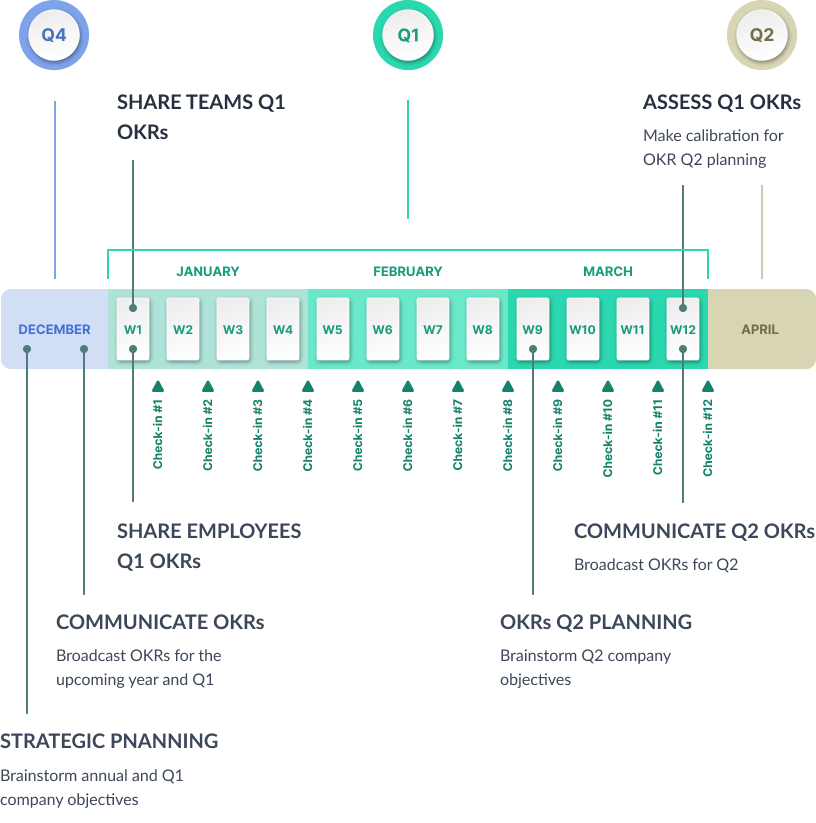
Brainstorm annual and Q1 company objectives
4-6 weeks before the quarter
A strategic session is a perfect format of group work that allows a company to discuss key business goals. C-level managers discuss priorities and set annual objectives that can help guide the direction of the entire company.
Broadcast OKRs for the upcoming year and Q1
2 weeks before the upcoming quarter
The results the team achieves at the end of the strategic session will help create a strategy. Based on this data, leaders can also set company-level OKRs for Q1. It is vital to expose them to the entire organization so that the participants on all levels can build their OKRs.
Share teams Q1 OKRs
Start of quarter
Teams set their objectives in reliance on the company’s OKRs and share them at their meetings. OKR alignment links different organization levels together. OKR alignment may be executed top-down, bottom-up, or as a combination of both. The result is aligned OKRs for the whole company, which are transparent to all employees.
Share employee Q1 OKRs
1 week after the start of the quarter
As soon as team OKRs are defined, team members share their OKRs. It may require prior negotiation with their managers. Typically this happens during one-on-one meetings.
Track progress through regular check‐ins
Throughout quarter
Regular OKR check-ins
Teams begin a rhythm of regular OKR check-ins. It allows teams to track progress on a regular (e.g., weekly) basis and change tactics as needed and remove obstacles along the way.
During the check-in, an employee and their manager assess how likely they are to fully achieve their OKRs, discuss blockers, and change the objectives if required. While communicating via check-in reports, employees and their managers may highlight important topics and discuss them later in more detail during one-on-one meetings.
It is vital to develop a habit of OKR check-ins and conduct them weekly or bi-weekly because they help employees track their progress during the quarter.
Success celebration
In addition to check-in meetings, it is very useful to hold separate success celebration meetings. Such meetings could be conducted once a week, bi-weekly, or monthly. Success celebration meetings are a perfect opportunity for teams that have set super-ambitious goals and achieved significant progress, to share their successes and get a boost of motivation from colleagues. Also, such teams fuel back the motivation of other participants.
Near the end of the quarter
Employees assess Q1 OKRs.
Before the planning session, it would be good to have a retrospective. During the retrospective meeting, teams can look back at the dynamics of OKRs achievement and analyze what was good and where mistakes were made, where problems were encountered, and how they can be prevented in the next stage. Such analysis helps make a calibration while setting OKR for the next quarter.
 OKR and Performance management
  OKR and Performance management