

As one of the most efficient goal-setting and management frameworks, OKRs (Objectives and Key Results) can bring true value to all business units, helping teams focus on what matters and achieve measurable results. Marketing is no exception. Here’s everything you need to know about marketing OKRs, including the OKR marketing definition, why and how to create OKRs for marketing, along with some examples you can use as guidance when crafting OKRs for your own marketing team.
What are Marketing OKRs and Why Set OKRs for Marketing
Despite the primary marketing goal of building brand awareness, marketing units may be involved in a variety of activities like capturing leads, leveraging content, increasing user engagement, managing social media and email campaigns, improving SEO, etc. Well thought out marketing OKRs make it easier for marketing teams to stay focused on the most important marketing efforts while juggling a bunch of responsibilities.
OKRs also help to align your marketing goals with the long-term business strategy as well as sync with other teams within your organization. OKRs increase your marketing team’s ability to generate consistent, quantifiable outcomes that drive sustainable business growth.
How to Write Good OKRs for Marketing Teams
Let’s take a closer look at how you can set OKRs for your marketing department in 3 basic steps to take your team’s performance to the next level:
-
Align your marketing goals with company objectives
Marketing team OKRs are typically set from the top down to align with your high-level corporate goals. E.g., if you aim at growing your annual revenue from $100K to $300K, you can turn that organizational goal into a smaller and more specific marketing goal of improving your lead generation pipeline.
-
Formulate a clear and ambitious Objective
For the goal mentioned above, the Objective can be formulated as ‘Increase the number of MQLs (marketing-qualified leads) by 30%’. Objectives must be concise, clearly stated, and easily understandable. On top of that, they must be ambitious, inspiring, and drive meaningful change.
-
Define measurable Key Results
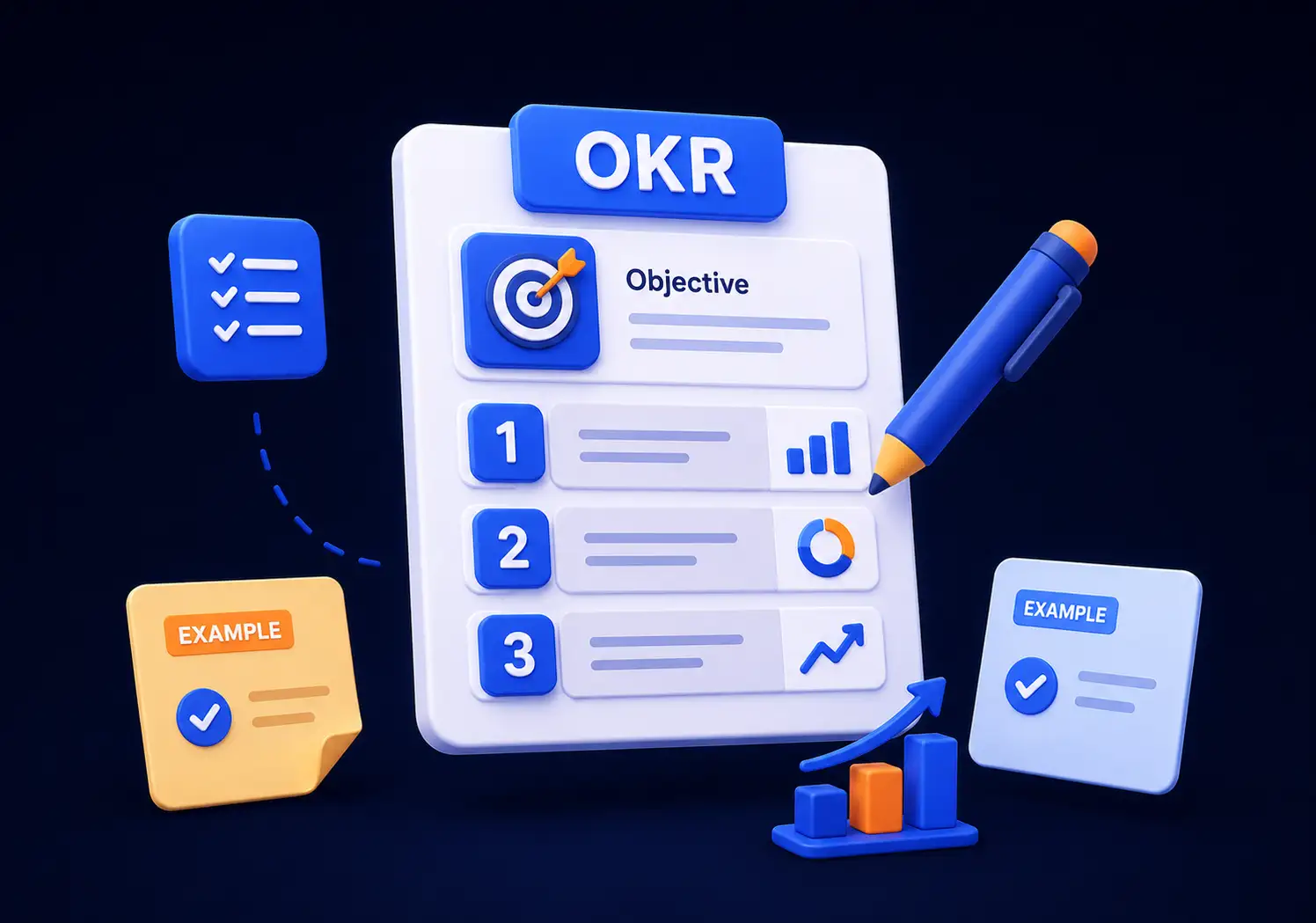
Once the Objective is clear, define 3–5 Key Results that will tell you whether your Objective has been achieved (e.g., ‘Generate 100 monthly MQLs from email marketing’). Key Results must be outcome-driven, measurable, time-bound, and linked to your team’s daily tasks.
Marketing OKR Examples
Though OKRs is a simple and straightforward goal-setting method in its essence, marketing teams might find it challenging to actually define and formulate the right Objectives and link them to the relevant, measurable Key Results. Check out some of the OKR marketing examples that you can use for inspiration:
1. Product Marketing OKR Examples
Product marketing is all about bringing your product to the market, communicating its value to customers, aligning product positioning with customer needs, and increasing product demand after its launch. Your product marketing OKRs could focus on anything in between. Here are some of the examples:
Objective: Achieve better user engagement with our product
Key Results:
- Improve NPS score from 60% to 80%
- Get a 20% increase in the number of return users
- Decrease churn rate by 15%
Objective: Drive more paying customers
Key Results:
- Improve visitor to trial conversions by 20%
- Achieve trial to paid conversion rate of over 30%
- Get 200 paying customers to join our referral program
Objective: Improve our product’s reputation
Key Results:
- Improve CSAT (Customer Satisfaction Score) by 20%
- Decrease review response time by 70%
- Set new guidelines for responding to negative feedback
2. Inbound Marketing OKR Examples
Inbound marketing refers to any marketing activities that capture the attention of your target audience and convert visitors into qualified leads. When setting your inbound marketing OKRs, think about the goals that involve increasing the number of leads coming to your website and how you can engage them for better conversions. Below are some of the examples:
Objective: Generate a solid pipeline of Marketing Qualified Leads (MQLs)
Key Results:
- Acquire 250+ MQLs from email marketing campaigns
- Acquire 200+ MQLs from LinkedIn Ads
- Acquire 350+ MQLs from gated content
Objective: Boost our customer acquisition engine
Key Results:
- Increase trial sign-ups by 50%
- Increase trial to paid conversion rate by 30%
- Generate at least 100 demo requests per month
Objective: Bring a record number of inbound leads to our website
Key Results:
- Increase the number of monthly site visitors from 5K to 15K
- Reduce homepage bounce rate by 50%
- Increase the number of sign-ups by 60%
3. Digital Marketing OKR Examples
As part of a broader marketing strategy, digital marketing involves a variety of techniques to manage a company’s online presence through digital channels, including website, paid search, email, and social media to increase traffic, engagement, and conversions. Check out some of the digital marketing OKR examples below:
Objective: Optimize our landing page for better conversions
Key Results:
- Increase landing page CTR by 10% through A/B testing
- Reduce landing page bounce rate by 20%
- Increase landing page sign-ups by 30%
Objective: Improve our website’s user experience
Key Results:
- Reduce average page load times from 4 to less than 1.5 seconds
- Increase the average time visitors spend on important pages by 25%
- Add custom made infographics and visuals to at least 10 pages or blog posts
Objective: Achieve maximum ROI from our PPC campaign
Key Results:
- Increase PPC conversion rate by over 50%
- Reduce CPC by 60%
- Improve return on ad spend by 50%
4. Growth Marketing OKR Examples
Growth marketing OKRs would typically focus on improving customer acquisition, loyalty and retention, driving better ROI and increasing revenue – all backed by research and data-driven metrics. Below are some of the examples of growth marketing OKRs:
Objective: Increase revenue growth rate
Key Results:
- Increase user acquisition by at least 40%
- Improve retention by 40%
- Increase profit margin by 15%
Objective: Boost customer loyalty and retention
Key Results:
- Develop the ideal customer profile
- Build a new customer loyalty program and implement it by the end of Q3
- Reduce customer churn rate by 20%
Objective: Increase customer lifetime value
Key Results:
- Decrease churn rate by 20% through improved user onboarding
- Increase annual subscriptions by 15%
- Grow average revenue per user by 40%
5. PR and Brand Marketing OKR Examples
PR and brand marketing OKRs should revolve around enhancing your brand awareness, increasing brand reputation, credibility, and authority, improving brand communication and brand image. As an example, your PR and brand marketing OKRs could look like these:
Objective: Improve our brand communication
Key Results:
- Publish 10 how-to guides and tutorials on our YouTube channel
- Shorten response time by 50% across all channels
- Increase CSAT score from 70% to 90%
Objective: Position our brand as an industry authority
Key Results:
- Collaborate with 3 micro-influencers and make them our brand ambassadors
- Establish guest blogging relationships with 5 high-profile industry blogs
- Hold 3 webinars on industry hot topics with 300+ participants
Objective: Increase the number of positive brand reviews
Key Results:
- Run a review campaign with high NPS customers
- Respond to 100% of customer reviews within 48 hours
- Establish guidelines for responding to negative reviews
6. Content Marketing OKR Examples
Content marketing is an essential facet of inbound marketing that helps increase traffic and boost engagement with your prospects and customers. Content marketing OKRs may focus on anything related to creating high-value content, publishing and distributing it to your target audience. Take a look at some of the content marketing OKR examples:
Objective: Improve our blog performance and authority
Key Results:
- Publish new blog posts based on top 10 target keywords to reach 3,000 unique visitors
- Increase blog subscribers by 50%
- Create 5 interview-based articles from own interviews with industry experts
Objective: Enhance our content distribution strategy
Key Results:
- Get 5 own guest articles published in the industry related online publications
- Identify 10 new channels, communities or forums to publish our content
- Double blog traffic coming from communities and forums
Objective: Boost our weekly newsletter performance
Key Results:
- Increase the number of newsletter subscribers by 50%
- Increase newsletter open rate from 20% to 30%
- Achieve 9% newsletter click-through rate
7. Email Marketing OKR Examples
Setting email marketing OKRs is essential to improving your team’s email marketing efforts and ensuring the efficiency of your email campaigns. Email marketing OKRs can include anything from growing your email lists and engaging your audience through drip campaigns to increasing email conversions. See some of the examples below:
Objective: Boost our email marketing ROI
Key Results:
- Grow our email list through organic channels by 25% per month
- Increase demo requests by 60% through an email campaign
- Build and implement an email campaign to re-engage lapsed customers
Objective: Revamp our trial onboarding email sequence for better conversions
Key Results:
- A/B test emails and subject lines on each email in the sequence
- Increase average email open rate to 30%
- Improve trial-to-paid conversions by 40%
Objective: Successfully implement a bi-weekly newsletter
Key Results:
- Grow an email list to 1K subscribers
- Reach an open rate of over 25% for email newsletters
- Maintain an unsubscribe rate of less than 2%
8. Social Media Marketing OKR Examples
Setting social media marketing OKRs will help your team expand your social media reach to boost brand awareness, enhance engagement with your target audience, increase social click-through rates and bring in more leads from social media channels. Check out some of the SMM OKR examples:
Objective: Grow our social media audience and presence
Key Results:
- Increase the number of followers from 5K to 15K across all platforms
- Increase organic average post reach by 50%
- Expand our social media presence through TikTok and YouTube
Objective: Take our social media engagement to the next level
Key Results:
- Improve social media engagement rate by 30%
- Reduce social media response time by 80%
- Increase social media CTR from 3% to 5%
Objective: Make social media an effective lead generation tool
Key Results:
- Grow social organic traffic by 50%
- Increase monthly website visitors from social media by 30%
- Increase monthly sign-ups from social media by 20%
9. Search Engine Optimization (SEO) Marketing OKR Examples
With Search Engine Optimization (SEO) OKRs, you can significantly improve your website’s search rankings for desired keywords and increase your organic traffic. SEO OKRs can range from developing your keyword strategy and optimizing your site’s content to tweaking your on-page and off-page SEO, etc. Here are some of the examples:
Objective: Improve our website’s on-page SEO
Key Results:
- Decrease our site’s loading speed from 5 to 2 seconds for 90% of pages
- Ensure 100% of pages have optimized titles and meta descriptions
- Achieve a health score of 100 on Ahrefs
Objective: Boost our site’s SEO ranking
Key Results:
- Rank in top 5 search results on Google for 5 primary keywords
- Increase search visibility by 50% for 5 primary keywords
- Increase organic search traffic by 30% for 3 main keywords
Objective: Enhance user engagement on our website
Key Results:
- Ensure bounce rate is below 40% for top 5 pages
- Increase average session duration to 3 minutes for top 5 pages
- Improve goal conversion rate by 20% on top 3 conversion pages
10. Event Marketing OKR Examples
Setting event marketing OKRs will help your team fully leverage event marketing to build better brand awareness and generate more qualified leads to your business by hosting or attending industry events. Here are some of the event marketing OKR examples to achieve these goals:
Objective: Raise our brand visibility and awareness at the event
Key Results:
- Get included in 10+ pre-event and post-event articles as an event participant
- Generate 300+ leads throughout the event
- Achieve 20% post-event engagement from event attendees
Objective: Build a successful outbound marketing strategy
Key Results:
- Secure 3 speaking slots at industry events
- Sponsor 2 industry events with 300+ participants
- Increase the number of event-driven leads by 50%
Objective: Get the most ROI from participating at the event
Key Results:
- Generate 200+ high-qualified leads
- Book 15 on-site meetings during the event
- Generate 100K in revenue from the event
Key Takeaways
OKRs can greatly add up to the efficiency and productivity of any business unit, including marketing. With the right set of marketing OKRs your marketing team will have a better understanding of where they should focus their marketing efforts and how to link their team goals to quantifiable outcomes. Use the OKR examples above when defining Objectives and Key Results for your marketing team to improve focus, team alignment, and enhance performance. With OKR management tools like EffortBox you can set, manage, and track progress of your marketing OKRs effortlessly and efficiently.
 OKR and Performance management
  OKR and Performance management
  OKR and Performance management